Posted in Articles and Links

Researcher claims virtual reality games can predict the future


From DIGITAL JOURNAL:
Mar 27, 2010 by Stephenie Deering
 
Sociologist William Sims Bainbridge uses the game World of Warcraft to gain insights into human behaviour. It is not a new idea, but it is a growing field of study.
People have used cards, sticks, coins, bones, and heavenly bodies for hundreds of years trying to divine the future. Many of these past-times, such as the Chinese I Ching, the Tarot and astrology live on. People are almost obsessed with knowing the outcome of the future, both in the short term and in the long term, and this includes scientists. Sociologist William Bainbridge uses a non-traditional method of divining the future. He studies human behaviour in on-line virtual reality games, such as World of Warcraft, to look at societal belief systems and to forecast the future of human beliefs. Bainbridge notes alternative reality games like World of Warcraft can answer real-life questions through play because the game deals with current real-life issues.

In an interview with New Scientist reporter, Samantha Murphy, Bainbridge likened World of Warcraft to Tolkein’s Lord of the Rings, saying

“… Tolkien believed that all good people could come together on the same side. This is one of the biggest questions that humanity faces: can we have a world consensus by which we’re all partners in finding a solution? Or, like the Hoarde vs Alliance situation in WoW, are we doomed to be in separate factions competing ultimately to the death? It touches on very serious issues but in a playful way.”

Dr. Jane McGonigal has taken questions like these and created an alternate reality game that aims to change the real world. Evoke is a short-term game in which creators hope to impart skill sets on players — real skills that can be applied in the real world. Evoke takes gamers through ten weeks of set goals to achieve, and at the end of the game, players will have viable business ideas and will be matched up with mentors — all with the idea of changing the real world. The game got underway earlier this month.


Most video games ask little else of players than to dedicate 10 hours or so of their time to save a virtual princess or prevent the world’s destruction.

But what if a game challenged players in real life and required them to develop and utilize skills beyond button-mashing or Wii-mote waving? (Very cute) Game designer Jane McGonigal and the team behind upcoming alternate reality game (or ARG) “EVOKE” wants to find out.

We got in touch with McGonigal to find out just what “EVOKE” actually is, and why people should be paying attention.

To hear exactly what “EVOKE” entails is to immediately be struck by the scope of the venture. It’s at once a pie-in-the-sky project based around empowering people to make positive changes to the world around them, but based around social gaming conventions to lure in people familiar with online games. “EVOKE” is like “World of Warcraft,” but instead of vanquishing orcs you’re fighting hunger; instead of raiding dark dungeons, groups band together to solve the energy crisis. If it sounds like a game with an agenda, that’s because it is.

http://www.asylum.com/2010/02/26/jane-mcgonigal-mmorpg-urgent-evoke-uses-gamers-to-change-the-world/

Posted in Articles and Links, News based on events in the Virtual World of Bali Hai

New Model Lets Researchers Crawl Through Virtual Brain Networks


FROM POPSCI

article by Rebecca Boyle posted 3/10/2011

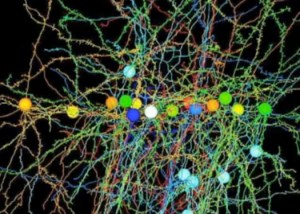
Using a combination of microscopy methods, Harvard researchers have untangled part of the circuitry of the cerebral cortex, illuminating brain connections in 3-D. A new neural circuit model will allow researchers to crawl through the individual connections in a neural network.

Scientists have come a long way in imaging the connections among neurons in flies and mice, and can watch the brain process various types of information by watching neuron activity. But monitoring this activity shows scientists what the neural circuits are doing, not how they’re doing it. Understanding the ways in which neurons connect and communicate would shed more light on how the brain works, especially the cerebral cortex, the seat of consciousness and memory.

But this is hard to do, as a Harvard Medical School release explains: One cortical circuit contains tens of thousands of neurons, each of which makes tens of thousands of connections, totaling more than 1 billion individual connections. Untangling a tiny sliver of this web required a pair of microscopy techniques and a supercomputer.

“In a visual circuit, we’ll interpret the data to reconstruct what an animal actually sees. By that time, with the anatomical imaging, we’ll also know how it’s all wired together,” he said.

Article link: http://www.popsci.com/science/article/2011-03/new-brain-circuit-model-demonstrates-how-neural-networks-work

Posted in Articles and Links

Science Thrives in Virtual Worlds


From COSMIC LOG on MSNBC: by Alan Boyle, MSNBC science editor

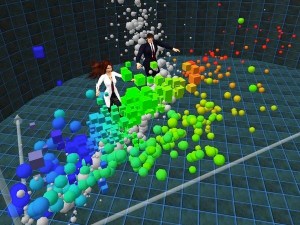
Second Life residents Desdemona Enfield and Curious George work on a virtual-reality visualization that classifies stars, galaxies and quasars according to their colors, brightness, distance and morphology.

Does the virtual-reality world known as Second Life have anything to offer for real-world scientists? Absolutely — and a trailblazing researcher says the payoffs are sure to increase when the Internet goes 3-D.

“We are really meant to interact in 3-D, with other people and with information,” Caltech physicist George Djorgovski, director of the Meta Institute for Computational Astrophysics, told me today during an interview in Second Life. “Because this works so well with the human perception system, as soon as there is an easy and ‘good enough’ 3-D approach, people will switch en masse.”

Djorgovski joined Second Life three years ago, and today his avatar (“Curious George”) seems totally comfortable in the world. (I, on the other hand, still walk over chairs, even though I’ve been an occasional Second Lifer for four years.) The Meta Institute for Computational Astrophysics presents a series of professional seminars, workshops and popular talks in Second Life, including a couple that I’ve presented. In addition, Djorgovski regularly meets with scientific collaborators in Second Life to work on his real-world research, which focuses on galaxy formation and evolution, quasars, sky surveys and data visualization.

You’ll find plenty of virtual experiments in SploLand, the Second Life science center operated by San Francisco’s Exploratorium.  “We’re using it as an extension of our exhibit space, to do things for our online visitors that we can’t do in the real world,” Rob Rothfarb, the Exploratorium’s project director for online engagement, told me today.

article link: http://cosmiclog.msnbc.msn.com/_news/2011/03/25/6344843-science-thrives-in-virtual-worlds?gt1=43001

Posted in Articles and Links

Artificial Intelligence


Does it bother you, Miranda–not being real?

Define “real.”

In this case “real” means to be born and then to make your way–to fight in order to continue existing, and to procreate.

No, Gunter, it does not bother me because I see no advantage in being “real.”

p. 264


Buzzle. Com:

Artificial Intelligence and the Future of Man

By Earl Hunsinger

Technology is a ubiquitous part of our daily life. Some feel that, through nanotechnology, it will soon be a part of us. They also believe that computers with artificial intelligence will be able to out-think us.

How fast is technology changing? According to many experts, faster than the majority of us think or are prepared for. According to one futurist, Ray Kurzweil, “we will have both the hardware and the software to achieve human level artificial intelligence with the broad suppleness of human intelligence including our emotional intelligence by 2029.” If that sounds like something from a scary movie (“Terminator” may come to mind), Mr. Kurzweil says not to worry, such super machines will also have morals and respect us as their creators (the people in scary movies rarely think that anything bad will happen to them either). He also believes that humans themselves will be smarter, healthier, and more capable in the near future by merging with our technology. For example, tiny robots implanted in our brains will work directly with our neurons to make us smarter (this may call to mind some other movies).

http://www.buzzle.com/articles/artificial-intelligence-and-the-future-of-man.html


Posted in Articles and Links

The Earth Simulator


What is the UK-Japan Climate Collaboration ?

http://www.earthsimulator.org.uk/index.php?option=com_frontpage&Itemid=1

The aim of the UJCC project is to exploit the power of the Earth Simulator to produce world-leading climate simulations. The enhanced resolution models will allow unprecedented fidelity of simulation, and allow many emergent phenomena to be resolved. The science of the project will then be to understand how the increased resolution changes the large scale mean climate, consider whether the emergent processes are therefore essential to produce reliable climate models, and consider if these processes can be parameterized in lower resolution models, or if their importance is enough to drive model resolution to increase.

Posted in Articles and Links, science fiction

Virtual things to come?


A bit cheesy but worth a look (and listen–Future boy talks like Sean Connery)

http://www.youtube.com/watch?v=ZJTnChBdmrU

Future city and all kinds of other Future stuff video (alas no more colonials or columns) plus ghost of Christmas shopping Future

http://www.youtube.com/watch?v=0jU9KzsU0zo&feature=related

Robot with a Rat Brain

http://www.youtube.com/watch?v=1-0eZytv6Qk&feature=relmfu

Posted in Articles and Links

EarthSky 22: The March 19 supermoon


Posted Mar 18, 2011

Moon. Supermoon. Extreme supermoon. Hey, it’s just the moon, and it’s happened millions of times before in Earth history. The explanation and more for you … on the 22.


EarthSky – a clear voice for science for broadcast and the Internet – advocates science as a vital tool for the 21st century.

Link: http://earthsky.org/human-world/earthsky-22-the-march-19-supermoon

Posted in Articles and Links

From Bot Girl’s Second Life Diary: Erotic Chat as an Exemplar of Sense Extension in Virtual Worlds


Thursday, April 30, 2009

Erotic text chat is an exemplar of sense extension within virtual worlds. It can evoke sights, sounds, smells, tastes, sensations and actions that are otherwise difficult or impossible to create visually within the digital world. Intentional activation of the imagination can induce powerfully realistic experiences because the brain does not qualitatively distinguish between physically produced and intensely imagined sensory experience. For instance, studies have shown that the brain is activated by imagined smells and tastes in the very same way it responds to actual sense impressions.

Link to article: http://botgirl.blogspot.com/2009/04/erotic-chat-as-exemplar-of-sense.html

Posted in Articles and Links

Avatars and Virtual Immortality By William Sims Bainbridge


“As people gain more and more avatars, agents, and other technology-based expressions of themselves, the scope for action during their lives increases, and the possibility of life after death becomes progressively more real. Buckminster Fuller said, ‘I seem to be a verb.’

I say, “I am a plural verb, in future tense.”

This quote is from  an  online article by William Bainbridge, a sociologist involved in online games. Bainbridge’s  article focuses on our present use of avatars as well as our future use. The article is from the online journal which is part of THE WORLD FUTURIST SOCIETY, an organization of scientists and those non-scientists who are interested in technology and how it will impact and ultimately redefine humanity. Because so much of this  science is part of the setting of Babylon Dreams, a novel I wrote because of my own fascination with this technology, I am now a member (non-scientist–you need to be an actual scientist to be a big kid member, but then that’s a lot more expensive).

If you’re interested in joining, here’s the link: http://www.wfs.org/faq

Posted in Articles and Links

Holos Now and Then


From MIT news:

3-D TV? How about holographic TV?

Using a single Xbox Kinect and standard graphics chips, MIT researchers demonstrate the highest frame rate yet for streaming holographic video.

January 24, 2011

Larry Hardesty, MIT News Office

The Consumer Electronics Show in Las Vegas in January 2010 was abuzz about a slew of prototype 3-D TVs, but if new research from the MIT Media Lab is any indication, holographic TVs could be close behind. At the Society of Photo-Optical Instrumentation Engineers’ (SPIE) Practical Holography conference in San Francisco the weekend of Jan. 23, members of Michael Bove’s Object-Based Media Group presented a new system that can capture visual information using off-the-shelf electronics, send it over the Internet to a holographic display, and update the image at rates approaching those of feature films.
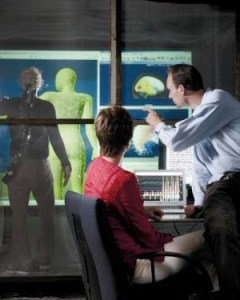
In November, researchers at the University of Arizona made headlines with an experimental holographic-video transmission system that used 16 cameras to capture data and whose display refreshed every two seconds. The new MIT system uses only one data-capture device — the new Kinect camera designed for Microsoft’s Xbox gaming system — and averages about 15 frames per second. Moreover, the MIT researchers didn’t get their hands on a Kinect until the end of December, and only in the week before the conference did they double the system’s frame rate from seven to 15 frames per second. They’re confident that with a little more time, they can boost the rate even higher, to the 24 frames per second of feature films or the 30 frames per second of TV — rates that create the illusion of continuous motion.

For article: http://web.mit.edu/newsoffice/2011/video-holography-0124.html

Posted in Articles and Links

The Real Avatar: Swiss Researchers Use Virtual Reality and Brain Imaging to Hunt for the Science of the Self


Accessed from Science News:

Science Daily Article –Feb. 18, 2011

Material from Ecole Polytechnique Fédérale de Lausanne via Eureka Alert

That feeling of being in, and owning, your own body is a fundamental human experience. But where does it originate and how does it come to be? Now, Professor Olaf Blanke, a neurologist with the Brain Mind Institute at EPFL and the Department of Neurology at the University of Geneva in Switzerland, announces an important step in decoding the phenomenon. By combining techniques from cognitive science with those of Virtual Reality (VR) and brain imaging, he and his team are narrowing in on the first experimental, data-driven approach to understanding self-consciousness.

Entire Article: http://www.sciencedaily.com/releases/2011/02/110217124901.htm

Posted in Articles and Links

Smart Homes: Is AI the Ghost in the Machine?


From Singularity

by Nikki Olson on March 7, 2011

When we conceptualize AI, we often forget that it is not something that has to operate in a single location, or have intelligence qualities like our own. We are already surrounded by AI systems that are nothing like our own intelligence, that utilize many machines spread out over large distances, and are equally ‘present’ in many locations.

In the future we will bring AI systems like these into our homes in the form of ‘smart environments.’  In doing so we introduce new and interesting relationships between man and machine. However, there may be some limits as to how ‘alive’ we want our AI homes to be.

For entire article–

http://singularityblog.singularitysymposium.com/smart-homes-is-ai-the-ghost-in-the-machine/

Posted in Articles and Links

A Small Quantum Leap


New switching device could help build a dream: the ultrafast quantum Internet

March 10, 2011 | Research

EVANSTON, Ill. — Northwestern University researchers have developed a new switching device that takes quantum communication to a new level. The device is a practical step toward creating a network that takes advantage of the mysterious and powerful world of quantum mechanics

The researchers can route quantum bits, or entangled particles of light, at very high speeds along a shared network of fiber-optic cable without losing the entanglement information embedded in the quantum bits. The switch could be used toward achieving two goals of the information technology world: a quantum Internet, where encrypted information would be completely secure, and networking superfast quantum computers.

The device would enable a common transport mechanism, such as the ubiquitous fiber-optic infrastructure, to be shared among many users of quantum information. Such a system could route a quantum bit, such as a photon, to its final destination just like an e-mail is routed across the Internet today.

The research — a demonstration of the first all-optical switch suitable for single-photon quantum communications — is published by the journal…

link to entire article: http://www.northwestern.edu/newscenter/stories/2011/03/quantum-communication.html

Posted in Articles and Links

“Forget the Singularity—biology will trump technology,” insists Mr Enriquez.


From “The New Overlords” THE ECONOMIST March 10, 2011 print edition

“…But what if the biggest breakthroughs come in improving man himself? Some technology experts think mankind will transform itself into a fitter, smarter and better-looking species in coming decades—a blink of an eye in evolutionary terms. Juan Enriquez and Steve Gullans argue in “Homo Evolutis”, a new electronic book, that the leapfrogging advances seen today in biotechnology, gene therapy, epigenetics, proteomics and a myriad of related fields are turbocharging evolution itself. ‘Forget the Singularity—biology will trump technology,’ insists Mr Enriquez…”

http://www.economist.com/node/18329616?story_id=18329616&fsrc=rss

..From ars Technica Website 2009:”We Are Becoming a New Species”

http://arstechnica.com/science/news/2009/02/we-are-becoming-a-new-species-we-are-becoming-homo-evolutis.ars..

..

At TED 2009

” …Chairman and CEO of Biotechonomy, Enriquez says that humanity is on the verge of becoming a new and utterly unique species, which he dubs Homo Evolutis. What makes this species so unique is that it “takes direct and deliberate control over the evolution of the species.” Calling it the “ultimate reboot,” he points to the conflux of DNA manipulation and therapy, tissue generation, and robotics as making this great leap possible.

We are already in the midst of minor improvements to the human body and mind; Enriquez gave examples of growing new tissues for successful transplant, programmable cells, and augmenting our abilities through robotics. As this trend accelerates, more and more aspects of the human experience, of the human life, will be capable of scientific manipulation. While some improvement may come post-birth, our understanding of DNA and biology may lead to something much bigger….”

2010 Juan Enriquez and Steve Gullans Website: “HOMO Evolutis: Please meet the next Human Species

http://homoevolutis.com/

Posted in Articles and Links

During Climate Hearing, Markey Asks If Anti-Science GOP Will Repeal


Gravity, Heliocentrism, Relativity

With sardonic humor, Rep. Ed Markey (D-MA) mocked today’s markup of legislation to overturn the scientific finding that fossil fuel pollution is causing dangerous climate change. Markey, who championed climate legislation that passed the House of Representatives in 2009, protested the energy subcommittee’s consideration of the Upton-Inhofe bill to overturn the Environmental Protection Agency’s rules on climate pollution, including its endangerment finding:

Mr. Chairman, I rise in opposition to a bill that overturns the scientific finding that pollution is harming our people and our planet.

However, I won’t physically rise, because I’m worried that Republicans will overturn the law of gravity, sending us floating about the room.

I won’t call for the sunlight of additional hearings, for fear that Republicans might excommunicate the finding that the Earth revolves around the sun.

Instead, I’ll embody Newton’s third law of motion and be an equal and opposing force against this attack on science and on laws that will reduce America’s importation of foreign oil.

This bill will live in the House while simultaneously being dead in the Senate. It will be a legislative Schrodinger’s cat killed by the quantum mechanics of the legislative process!

Arbitrary rejection of scientific fact will not cause us to rise from our seats today. But with this bill, pollution levels will rise. Oil imports will rise. Temperatures will rise.

And with that, I yield back the balance of my time. That is, unless a rejection of Einstein’s Special Theory of Relativity is somewhere in the chair’s amendment pile.

Watch it:

http://wonkroom.thinkprogress.org/2011/03/10/markey-flat-earthers/

Posted in Articles and Links

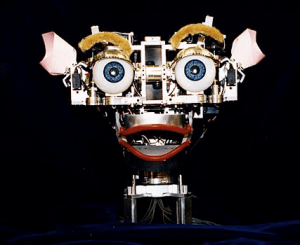
Love and Sex with Robots: The Next Step of the Relationship between Man and Machine?


Back in 2007, computer chess programming guru David Levy wrote a provocative book about robothuman relations entitled Love and Sex with Robots: The Evolution of Human-Robot Relationships. In it he made a number of bold predictions regarding future relations between humans and machines, the most surprising of which being that we would fall in love with robots.

Fast forward 4 years (and almost 3 Moore’s Law cycles) and it seems as though his predictions are no nearer coming true than they were when he made them. David Hanson’s skin has gotten more realistic and more people know about Hiroshi Ishiguro’s real looking androids, but many important developments stand in the way of our considering robots something we could one day fall in love with.

So what’s standing in the way of our moving more quickly toward robots as companions?

In an interview with Levy earlier this year, Dr. Kim Solez inquires into what obstacles there are in creating the robots envisioned in Love and Sex with Robots.

Perhaps surprising, Levy doesn’t think there are any real psychological obstacles in the way of our making robots our romantic companions. In fact, he thinks, “It’s almost entirely a question of investment.”

He explains:

“Up until now, most of the interest in robot-human relations has come from Japan and it’s well known that the Japanese government is facing a massive social problem in coming decades because of the percentage of its population that will at an age where they will need a lot of care and there simply won’t be enough people to provide that care.  And so the Japanese governments decided some years ago that the answer lay in developing robots, ‘carer robots’ to look after the elderly. I think that this is the main effort in the world in this direction and I’m sure that it will come to fruition because the problem faced by the Japanese government certainly won’t go away and their desire to implement the solution is really firm.”

For the rest of the article, here’s the link:

http://singularityblog.singularitysymposium.com/love-and-sex-with-robots-the-next-step-of-the-relationship-between-man-and-machine/