Category: Articles and Links
Pictures with articles and/or Links
Babylon Dreams book trailer
Protected: Babylon Dreams trailer
A link to the Kirkus review of Babylon Dreams
Eva, the smiling robot is blue
You’re a little creepy, Eva.
Deja Vu, a First Contact: There and back again
This weekend, I read Déjà Vu, a First Contact novel by sci fi author, Peter Cawdron. The big question is always: Are they friend or foe?
It’s the beginning of the 22nd century as we meet Jess, a young astronaut. Jess is busy doing maintenance while floating outside a huge spaceship, orbiting the Earth days before blasting off to a distant star system. Cawdron’s strength is with moment- to-moment details that put you there. Another is his extensive knowledge of what’s going on in astrophysics and where it might lead. Jess is tired and eager to complete her tasks so that she can re-enter and get some decent sleep. Jess’s spacesuit has become uncomfortable. A strand of hair is driving her nuts and she struggles to ignore it as thick padding on her fingertips makes push buttons a challenge.
Like Jazz, the protagonist of Cawdron’s My Sweet Satan, Jess must cope with shifting realty. In Jess’s case, reality shifts again and again.
The scene replays, but instead of the Earth, Jess sees another planet, a massive gas giant ringed in ice. Jess and we as readers are confused when we’re back to maintenance and the pesky strand of hair. The scene repeats, but Jess sees the strange planet again as she experiences her death when her ship explodes. And there’s something else—lots of eyes and they’re all looking at what’s left of her. Then she’s outside the ship again.
Not so fast, what’s going on? We and Jess want to know.
Jess starts questioning her reality and begins to mix it up, ditching the chores and doing space somersaults as her alarmed crew members panic. Then Jess finds herself in several familiar/unfamiliar environments, including Africa where she’s being chased by a lion and then slogging through a snowscape. Wtf is going on? We and Jess want to know. By force of will, Jess has escaped an amusement park time loop (you-are-there) VR fun ride and now finds herself in a huge part-time science lab.
Her sudden manifestation startles the young scientists who have been tinkering with what’s left of her, taken from the pieces of her ship, destroyed thousands of years earlier.
Much of Earth was destroyed when another spaceship bound for this same system exploded before it left orbit. Humanity made its way back technologically and here we are! What’s left of Jess is a chunk of brain resting in a glass jar with some wires. Okay! I love VR! Jess is understandably upset. The young scientists do their best to make her VR life comfortable and she learns that everyone is neuro-linked to “Veritas,” a super Google. Jess makes the best of it, including ignoring the flirtations of a young maintenance worker whom she calls “Pretty Boy.” Then Jess is attacked by the many-eyed aliens. Because the bad ET’s don’t know that she’s virtual, she and her brain jar escape with Pretty Boy’s help.
Pretty Boy takes Jess and her brain jar to see his grandfather, Gal. We learn that humanity is confined to a few small domed settlements on a hostile moon.
The oppressors are a coalition of AI’s and the many-eyed aliens who look like sea slugs. Gal gives Jess a whole new robot body that looks just like her. It’s a fem-bot with a cute little cabinet in the chest for her brain jar. When Gal asks why the many-eyed slugs would want to help the AI’s, Jess (she’s an astro-biologist) tells them that it’s all about what’s for dinner and we’re on the menu. When the aliens track Jess and her friends down, Jess grabs a flamethrower, sweeping it through rows of eyes ala “Say hello to my lil’ freh’ you alien bastards!” At last, taking one alien out, Jess dies in battle.
It is thousands of years later and Jess finds herself back on Earth. Her welcoming committee is a woman and a cow.
Humanity is back, but like the time after the other spaceship exploded, making half of the Earth uninhabitable, it’s been a struggle. Everyone is dirt poor, emphasis on the dirt. Somehow, Jess has been brought back, brains, body and all to the far future where there is no indoor plumbing. Regardless, everyone knows who Jess is and she’s treated like Beyonce.
Why? Jess has been brought back for a purpose. She’s going to the Moon
in a spaceship built from plans ala Apollo 11. I’ll leave it there, other than to say that before the denouement, Cawdron gives a detailed account of what the Apollo astronauts overcame, the importance of what they achieved and why people need to know.
I really enjoyed this book and read it in two sittings. The unpredictable plot kept me invested.
As to what happens at the end, does Jess complete her mission?
I’ll say this: In Galaxy Quest, a film made several years ago, a character’s motto is “Never give up; never surrender!” Some of us never do.
Disney’s new VR Jacket
From the Washington Post: 4/26/2018
Hugs and punches and snakes, oh my . . .
I’ll take a hug but hold the snakes.
What Dreams will you share on Facebook?
What if you could record your dreams and make a home movie?
I participated in an experiment that was part of
Daniel Oldis’ research on dreams, some of which is detailed in this CNN article (link is below).
CNN: How close are we to recording our dreams?
Wearing a device that recorded my brain waves while I slept, I became lucid and signaled to an online dream lab which recorded the signal.
Or as the little girl said in that long ago “Shake and Bake” commercial, “Ah helped!”
From AR: “The Ring” Holy crap!
Up close and personal, the Tinder date from hell:
Wolves in the Walls : VR and Neil Gaiman
The Nature of REALity
FROM: Pharnygula
Evolution, development, and random biological ejaculations from a godless liberal
The Nature of Existence
Posted on: February 3, 2011 9:40 AM, by PZ Myers
I forgot to mention that I did attend the local screening of The Nature of Existence, the new movie from Roger Nygard in which he traveled the world asking various people grand questions about the meaning of life, etc. It was entertaining, and it is subtly subversive of religious views, so I will recommend it. But I do have a few reservations that I was also able to bring up in the Q&A after the movie.
One thing that was alarmingly obvious when watching it is that almost all the gurus and authorities and religious figures that he interviewed were male. There were exceptions — the 12 year old daughter of his neighbor (who was an unrepentant atheist, and I thought the most sensible voice in the whole movie), a lesbian priest, the wife of a pastor — but otherwise, this show is one long sausage-fest. When I pointed this out, Nygard was apologetic and recognized that this is a significant omission, but explained that he simply hadn’t noticed when he was filming the material. Isn’t that the whole problem, that we’re oblivious to these omissions of half the population of the planet? Article: http://scienceblogs.com/pharyngula/2011/02/the_nature_of_existence.php
Posted on: February 3, 2011 9:40 AM, by PZ Myers
How Virtual Reality Will Change Who We Are
FROM BIG THINK
Parag and Ayesha Khanna on April 5, 2011, 7:22 PM

Today marked the publication of the new book Infinite Reality: Avatars, Eternal Life, New Worlds, and the Dawn of the Virtual Revolution by Jeremy Bailenson and Jim Blasocovich.
Infinite Reality gets inside all of the technologies and animation that we now take from granted, from Wii video games to movies like the Matrix and Avatar, and explains how this virtual reality is changing our reality.
In this video on the book’s website, the authors discuss how the human mind perceives interaction with digital avatars as real, opening a whole new world of possibilities for shaping the mind outside of normal social contexts:
Jeremy is the director of Stanford’s Virtual Human Interaction Lab (VHIL), and Jim, one of the original pioneers of virtual reality, teaches at the University of California in Santa Barbara. Very much related to the scope of this book, Jeremy’s recent research has shown the surprising ways in which just a few minutes spent in the virtual environments he has constructed change how we view ourselves and each other once we step back into the real world.
Unafraid to forecast decades into the future, Bailenson and Blascovich are at the forefront of showing how the lines between physical and virtual are blurring in our emerging hybrid reality. The book is a must-read for anyone interested in how the next generation of the Web – 3D immersive reality – will shape and transform us as we engage with it.
DaVinci Surgical Robot Plays ‘Operation’ Board Game, Saves Cardboard Life (Video)
FROM: SINGULARITY HUB
by Aaron Saenz April 7th, 2011
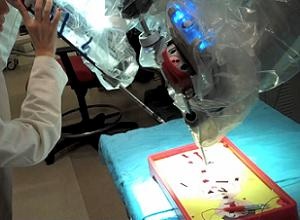 Modern life teaches us funny lessons like: if you can’t win at a child’s board game, use a multimillion dollar robot to cheat. PhD students at John Hopkins University’s Lab for Computational Sensing and Robotics (LCSR) ran into some trouble playing the classic board game Operation which requires you to remove tiny plastic organs from ‘Cavity Sam’ without triggering his electric alarm system and killing him. Their failure is a little daunting considering these guys are the next generation of surgical innovators. To overcome their limitations, those students hooked ‘Sam’ up to the da Vinci robot system from Intuitive Surgical. The video below shows the results. While this was all just a good natured joke, I’m glad the da Vinci robot and LCSR are getting some decent publicity from it. These robots, and the surgeons who use them, are saving thousands of lives each year and pushing us towards the future of medicine.
Huge Object brushes by Soyuz Spacecraft April5 2011
Transhumanism for Children
FROM SINGULARITY
 by Nikki Olson on March 31, 2011
It is often pointed out that Transhumanism shares many features with religion. It answers questions regarding the nature of the world and humanity’s place in it, it offers guidance on how to live, and inspires hope. However, there are a number of important things distinguishing it from a religion, such as the lack of belief in a Deity and its emphasis on the empirical method and reason. Another distinguishing feature relates to the obstacles associated with teaching Transhumanism to children.
Although being religious as an adult entails contemplation of many of life’s more difficult questions, following a religion can and does occur at very young ages. Children are able to contemplate God to some extent, usually via the anthropomorphized metaphor of ‘the father’, they are able to associate simple moral behaviors with ideas of reward and punishment, and they become enthralled in the ‘magic like’ elements of religious miracle.
Are children capable of contemplating Transhumanism?
Article: http://singularityblog.singularitysymposium.com/transhumanism-for-children/
Giant Squid Eye, 2008
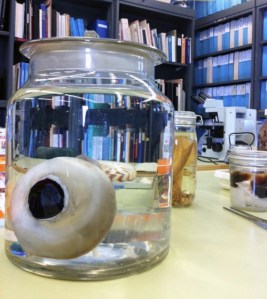 From the Smithsonian: http://newsdesk.si.edu/snapshot/giant-squid-eye
Giant squid have the largest eyes in the animal kingdom—at up to 10 inches in diameter, they are the size of a dinner plate. These massive organs allow giant squid to detect objects in the lightless depths where most other animals would see nothing.
The giant squid is among the largest invertebrates on Earth—with lengths measuring nearly 60 feet. Giant squid can descend to 6,500 feet and are known to be aggressive hunters.
The eyes, on either side of the head, each contain a hard lens. An image is focused by changing the position of the lens, as in a camera or telescope, rather than changing the shape of the lens, as in the human eye.
This item is one of 137 million artifacts, works of art and specimens in the Smithsonian’s collection. It is not currently on display.
More information at http://ocean.si.edu/ocean-life-ecosystems/giant-squid
I’ m sorry–could you please repeat that?
The perils of voice recognition:
http://www.youtube.com/watch?v=5FFRoYhTJQQ&feature=player_embedded#at=16
Oneironautics ~A Field Guide to Lucid Dreaming~

Scared of heights? Take this pill

From: THE TELEGRAPH
A pill could help people cure themselves of a fear of heights, a study suggests.
By Richard Alleyne, Science Correspondent
28 Mar 2011
Scientists have discovered that giving people a tablet of the stress hormone cortisol can help reduce their phobia.
The hormone, which is part of the body’s “fight or flight” reaction to danger, appears to open the brain up to being reprogrammed and to permanently remove anxieties.
Tests on 40 patients with acrophobia – a fear of high places and edges – found those given cortisol in combination with behavioural therapy dramatically reduced their aversion.
The researchers said their findings, published in Proceedings of the National Academy of Sciences, could lead to the development of effective treatments for a host of anxiety disorders.
Half the participants were given the drug and the others a placebo an hour before being subjected to a virtual-reality outdoor elevator ride.
Their fear was measured three to five days and one month after the last exposure session through an established acrophobia questionnaire and by sensors that picked up their sweat known as skin conductance examinations.
Compared with those given the dummy pill participants who took cortisol suffered significantly less anxiety and a smaller increase in skin conductance during follow-up.
The effect also lasted a lot longer and still apparent a month later.
Article Link: http://www.telegraph.co.uk/health/healthnews/8411753/Scared-of-heights-Take-this-pill.html
Researcher claims virtual reality games can predict the future
From DIGITAL JOURNAL:
Mar 27, 2010 by Stephenie Deering
Sociologist William Sims Bainbridge uses the game World of Warcraft to gain insights into human behaviour. It is not a new idea, but it is a growing field of study.
People have used cards, sticks, coins, bones, and heavenly bodies for hundreds of years trying to divine the future. Many of these past-times, such as the Chinese I Ching, the Tarot and astrology live on. People are almost obsessed with knowing the outcome of the future, both in the short term and in the long term, and this includes scientists. Sociologist William Bainbridge uses a non-traditional method of divining the future. He studies human behaviour in on-line virtual reality games, such as World of Warcraft, to look at societal belief systems and to forecast the future of human beliefs. Bainbridge notes alternative reality games like World of Warcraft can answer real-life questions through play because the game deals with current real-life issues.
In an interview with New Scientist reporter, Samantha Murphy, Bainbridge likened World of Warcraft to Tolkein’s Lord of the Rings, saying
“… Tolkien believed that all good people could come together on the same side. This is one of the biggest questions that humanity faces: can we have a world consensus by which we’re all partners in finding a solution? Or, like the Hoarde vs Alliance situation in WoW, are we doomed to be in separate factions competing ultimately to the death? It touches on very serious issues but in a playful way.”
Dr. Jane McGonigal has taken questions like these and created an alternate reality game that aims to change the real world. Evoke is a short-term game in which creators hope to impart skill sets on players — real skills that can be applied in the real world. Evoke takes gamers through ten weeks of set goals to achieve, and at the end of the game, players will have viable business ideas and will be matched up with mentors — all with the idea of changing the real world. The game got underway earlier this month.
Most video games ask little else of players than to dedicate 10 hours or so of their time to save a virtual princess or prevent the world’s destruction.
But what if a game challenged players in real life and required them to develop and utilize skills beyond button-mashing or Wii-mote waving? (Very cute) Game designer Jane McGonigal and the team behind upcoming alternate reality game (or ARG) “EVOKE” wants to find out.
We got in touch with McGonigal to find out just what “EVOKE” actually is, and why people should be paying attention.
To hear exactly what “EVOKE” entails is to immediately be struck by the scope of the venture. It’s at once a pie-in-the-sky project based around empowering people to make positive changes to the world around them, but based around social gaming conventions to lure in people familiar with online games. “EVOKE” is like “World of Warcraft,” but instead of vanquishing orcs you’re fighting hunger; instead of raiding dark dungeons, groups band together to solve the energy crisis. If it sounds like a game with an agenda, that’s because it is.
http://www.asylum.com/2010/02/26/jane-mcgonigal-mmorpg-urgent-evoke-uses-gamers-to-change-the-world/


