
Dreamstar http://www.dreamstar.com/index.php
Category: Articles and Links
Pictures with articles and/or Links
Foreword to Virtual Humans October 20, 2003 by Ray Kurzweil
This paragraph is from a 2003 Kurzweil article//
Article Link: http://www.kurzweilai.net/foreword-to-virtual-humans
“When we want to experience real reality, the nanobots just stay in position (in the capillaries) and do nothing. If we want to enter virtual reality, they suppress all of the inputs coming from the real senses, and replace them with the signals that would be appropriate for the virtual environment. You (i.e., your brain) could decide to cause your muscles and limbs to move as you normally would, but the nanobots again intercept these interneuronal signals, suppress your real limbs from moving, and instead cause your virtual limbs to move and provide the appropriate movement and reorientation in the virtual environment.”
Nano Nano
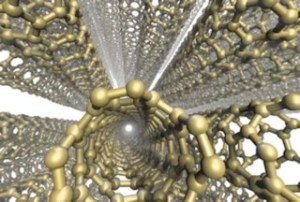
(VEI guarantees the whole you in PARADISE–our nanobots are cutting edge!)

Harvard Medical School’s Wyss Institute for Biologically Inspired Engineering and Dana-Farber Cancer Institute team have constructed a self-assembling nanodevice from single-stranded DNA using a design principal known as tensegrity to lash double-helix struts together with single-stranded DNA. The strands interconnect the struts and pull the entire piece into a taught shape resembling a twisting prism. The structures can further be programmed to change shape on call, as well as move of their own accord. While some nanotechnological advances are under FDA study for fears of tampering or tainting the human body, Harvard’s DNA devices are biodegradable and biocompatible. In their lives as possible drug ferries, mimicking viruses to deliver lethal drugs to targeted cells, they pose much less threat of eventual problems than solid state deliver devices such as carbon nanotubes. Once their mission is complete, the DNA machines can be safely destroyed in-vitro, leaving no troublesome refuse. Another possible use for the DNA constructs is the fine-tuning of cellular matrices to coax stem cells into becoming one type of cell or another. Stem cells differentiate their jobs in part by the the rigidity of their surrounding tissue. Stiff extracellular matrices can convince a stem cell to produce bone, while a more liquid mixture could generate neurons. Being able to fine-tune the shapes of the DNA devices could help to control the extracellular matrices, giving stem cells a preferred environment for a desirable piece of tissue growth.
http://www.dailytech.com/Harvard+Debuts+Selfassembling+Biological+Nanodevices/article18818.htm
Dream a Little Lucid Dream
Dreams Communication using the Internet
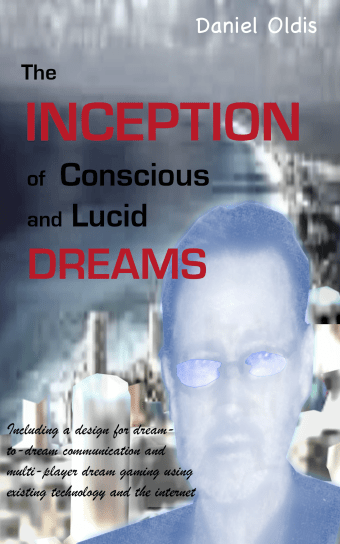
Daniel Oldis, whose seminal work in the science of lucid dreams is widely quoted in academic circles writes an introduction to his acclaimed Lucid Dream Manifesto in which he suggests that a lucid dreamer can signal another dreamer using dream masks and the internet.
Check out”Sleep Stream Online” a sleep lab that is studying sleep patterns with the goal of identifying when lucid dreaming is in progress. “Brian” an engineering student at Cornell, is using “Zeo” an easily worn device that records sleep patterns and sends the data to the sleepstream program. The goal is to synchronize lucid dreamers and explore ways to communicate dreamer to dreamer. This study is inspired by Oldis’ writings. Here’s the link:
http://www.sleepstreamonline.com/
Mind Uploading and Mind Children

There are two major questions surrounding the concept of mind uploading. There is the question of feasibility: Can we build a model of a brain complete enough to allow a conscious mind to emerge? The other question is concerned with identity. Some people argue that, if a copy of a conscious mind is identical by all measures (ignoring the fact that one is biological and the other is neuromorphic software/hardware) it should be thought of as a continuation of the mind that was mapped and uploaded. Others argue that a copy cannot be considered the same as the original, so the newly awakened consciousness must be another person.
Various attempts have been made to imagine the benefits of mind uploading. Assuming continuation of the mind, these benefits include indefinite lifespans and upgrading the mind. When your current brain no longer works well enough or not at all, you transfer your conscious mind to another (perhaps better) artificial brain. None of these benefits are tempting to those who see uploads as different people. In The Spike, Damien Broderick declared “copies are not you” and asked, “Would you be prepared to die (sacrifice your current embodiment) in order that an exact copy of yourself be reconstructed elsewhere, or on a different substrate?” He goes on to argue that this is not a procedure he would be willing to undertake. Let’s assume Broderick is right and a copy is indeed “not you.” Does it then follow that mind uploading offers no benefits?http://www.hplusmagazine.com/articles/virtual-reality/mind-uploading-and-mind-children
Gunter prepares to welcome the leader of the “Herd People,” a holo porn king who plans to come as a god–a cigar-smoking llama.


