
Tag: new science fiction
A link to the Kirkus review of Babylon Dreams
The Southern Reach Trilogy. Down the Rabbit Hole of Area X, A Review
Recently, I read Area X: The Southern Reach Trilogy by Jeff VanderMeer.
A film, based on the first first book of the trilogy, Annihilation had just been released. The trailer was so intriguing that I decided to read the book.
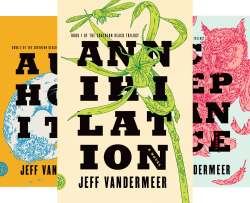
Annihilation, the first book of VanderMeer’s The Southern Reach Trilogy, is a fascinating read.
Area X includes a stretch of the Florida Coast, an island, a lighthouse and a sinister ecosystem. The Southern Reach is a research facility just outside the “Shimmer.” Focused on determining the nature of the threat posed by Area X, they continue to study it. Area X has existed, unknown to the public for decades.
An opaque barrier encloses Area X and it destroys anything—human or animal—that tries to enter.
Testing the barrier for openings, soldiers drive hundreds of unfortunate rabbits into the mysterious border. Some rabbits are torn apart; others disappear into Area X. Finally a “door” is discovered and a series of teams goes through. Almost no one returns. Those who do make it back have little or no memory of what they encountered.
Annihilation, the first of the trilogy, is a first person narrative. Identified only as the “biologist,”
the narrator is part of a four-member team that enters Area X. She learned of Area X when her soldier husband, whom she had presumed dead, returns to her. He had taken a top-secret assignment. His long absence meant something had gone wrong and he wasn’t coming back. When he returns, his affect is blank and confused. He is unable to remember what happened. In a matter of weeks, he dies of cancer. She wants to know what happened. What caused his death?
The biologist is, to say the least, self-contained.
In fact, when it comes to the how much influence her fellow humans have on her, the biologist is self-shrink-wrapped. On the other hand, when it comes to “Nature” and its myriad of habitats, she’s all touchy-feely. A mossy pond with lots of bugs, amphibians, animals and reptiles is her idea of great getaway. For the biologist, Area X, with apologies to all those poor rabbits, is Wonderland and she is Alice. Her account of what she experiences as she explores Area X is compelling and hypnotic.
Like “the biologist,” the other three are identified as their professions—psychologist, anthropologist and surveyor.
Names are verboten. From the beginning, team members are suspicious of each other. Other than where to go, what to do next and where to camp, there is little communication.
Looming in the distance is a lighthouse, thought to be the heart of what was wrong with Area X. At dusk she hears something moaning.
The lush, sinister landscape, crawling with strange insects (velvet ants?), a place where animals seem coldly observant, leads the team to an anomaly, something not detailed on the map, which was derived from satellite views and the limited information provided by survivors of Area X.
The team decides to explore the “anomaly,” a circular stone pit.
Stairs descend into the darkness below where the walls are covered with a strange biblical verse. Tiny plants and moss form the letters. While closely examining the writing on the walls , the biologist is exposed and contaminated. The result is she gains a heightened awareness and becomes sensitive to her surroundings.
Later, she returns to the “anomaly” and descends into the darkness.
What she encounters at the bottom of those stairs propels the reader into a dreamlike landscape of distorted reality and shifting timelines. The biologist’s alienation from her fellow humans makes her the perfect vessel for the strange nectar produced by Area X.
This book is a compelling narrative; I simply couldn’t stop reading, so I didn’t.
Authority is the second book in the “Trilogy,” Unlike Alienation, Authority is written in third person. “Control,” identifies a man, John Rodriguez, an outsider who is called in by the “Director” of the research facility. Control will investigate the reappearance of the “Biologist” and discover the truth of what occurred during the mission.
The tone of Authority is straight out of The X Files.
It’s rife with paranoia and conspiracy theories. We do learn more about the history of Area X and those who were there at the beginning. Like Annihilation, reality and time shifts as “Control” realizes that his name no longer defines him. As he struggles, Area X draws closer.
Like Annihilation and Authority, I found Acceptance engrossing and entertaining.
But at the end of the Acceptance, I had still had more question than answers. From the beginning, when reading Annihilation, I kept trying to define the why, the process that led to Area X. Throughout Acceptance, characters struggle to do the same. Through the characters’ search for answers, VanderMeer offers hints now and then, pieces of a puzzle that fail to define Area X clearly.
Like Lovecraft, VanderMeer’s Area X conveys something that regards us as disposable. It’s sinister and unknowable.
As far as a summer read, if you like science fiction rendered in rich, complex prose with a huge dollop of enigma, I recommend Area X, The Southern Reach Trilogy. But be warned, like a summer tan, long after you finish The Southern Reach Trilogy, the effects of Area X may linger.
Researcher claims virtual reality games can predict the future
From DIGITAL JOURNAL:
Mar 27, 2010 by Stephenie Deering
Sociologist William Sims Bainbridge uses the game World of Warcraft to gain insights into human behaviour. It is not a new idea, but it is a growing field of study.
People have used cards, sticks, coins, bones, and heavenly bodies for hundreds of years trying to divine the future. Many of these past-times, such as the Chinese I Ching, the Tarot and astrology live on. People are almost obsessed with knowing the outcome of the future, both in the short term and in the long term, and this includes scientists. Sociologist William Bainbridge uses a non-traditional method of divining the future. He studies human behaviour in on-line virtual reality games, such as World of Warcraft, to look at societal belief systems and to forecast the future of human beliefs. Bainbridge notes alternative reality games like World of Warcraft can answer real-life questions through play because the game deals with current real-life issues.
In an interview with New Scientist reporter, Samantha Murphy, Bainbridge likened World of Warcraft to Tolkein’s Lord of the Rings, saying
“… Tolkien believed that all good people could come together on the same side. This is one of the biggest questions that humanity faces: can we have a world consensus by which we’re all partners in finding a solution? Or, like the Hoarde vs Alliance situation in WoW, are we doomed to be in separate factions competing ultimately to the death? It touches on very serious issues but in a playful way.”
Dr. Jane McGonigal has taken questions like these and created an alternate reality game that aims to change the real world. Evoke is a short-term game in which creators hope to impart skill sets on players — real skills that can be applied in the real world. Evoke takes gamers through ten weeks of set goals to achieve, and at the end of the game, players will have viable business ideas and will be matched up with mentors — all with the idea of changing the real world. The game got underway earlier this month.
Most video games ask little else of players than to dedicate 10 hours or so of their time to save a virtual princess or prevent the world’s destruction.
But what if a game challenged players in real life and required them to develop and utilize skills beyond button-mashing or Wii-mote waving? (Very cute) Game designer Jane McGonigal and the team behind upcoming alternate reality game (or ARG) “EVOKE” wants to find out.
We got in touch with McGonigal to find out just what “EVOKE” actually is, and why people should be paying attention.
To hear exactly what “EVOKE” entails is to immediately be struck by the scope of the venture. It’s at once a pie-in-the-sky project based around empowering people to make positive changes to the world around them, but based around social gaming conventions to lure in people familiar with online games. “EVOKE” is like “World of Warcraft,” but instead of vanquishing orcs you’re fighting hunger; instead of raiding dark dungeons, groups band together to solve the energy crisis. If it sounds like a game with an agenda, that’s because it is.
http://www.asylum.com/2010/02/26/jane-mcgonigal-mmorpg-urgent-evoke-uses-gamers-to-change-the-world/


